Your real surface is the API, not the front end.
Whatever the UI enforces, the API answers directly. An attacker skips your interface entirely and talks to endpoints raw — and you’ve never tested what they return.
Your APIs expose your data and logic directly to clients and partners with no UI to hide behind — and probing every endpoint for object-level and authorization flaws is exacting, specialist work that a broad-scope pentest rarely does justice. That depth is what we focus on.
Trusted by





Whatever the UI enforces, the API answers directly. An attacker skips your interface entirely and talks to endpoints raw — and you’ve never tested what they return.
Authentication you trust. But per-object, per-function authorization across hundreds of endpoints is where APIs break — one missed check and any user reads any record.
Partners and customers integrate against your endpoints, and they expect it tested. A flaw here isn’t just your problem — it’s exposure across everyone you’ve integrated with.
Introspection, nested queries, and over-exposed fields hand attackers a map of your data model — and a way to abuse it for enumeration or denial of service.
SOC 2, ISO 27001, PCI, or a customer’s security review now calls out APIs explicitly. A generic web-app report doesn’t satisfy it — you need testing scoped to the interface itself.
Versioned, deprecated, internal, undocumented — endpoints accumulate faster than they’re inventoried. The forgotten v1 route with no auth is exactly what gets found first.
#1 risk
Broken object-level authorization (BOLA) tops the OWASP API Security Top 10 — and it’s the most common serious flaw we find, because confirming it means manually testing every object on every endpoint.
80%+
of web traffic is now API traffic — meaning the majority of your real attack surface lives where there’s no UI to constrain it.
1 endpoint
missing an ownership check can leak every record behind it. One forgotten endpoint is all an attacker needs.
Deep manual testing of every endpoint, method, and object — not just the happy path your docs describe.
We attack the API as an outside consumer with only what’s publicly reachable, discovering endpoints, versions, and methods the docs don’t mention.
Authenticated testing with credentials across roles, scopes, and tenants — plus schema or spec where available — so we exercise object- and function-level authorization at full depth.
Most security work stops at finding a vulnerability. We treat that as the starting point.
A senior pentester (not a sales rep) will get back to you with an honest read on what would actually be worth testing.
A few engagements that show what working with us looks like — at scale, over years, across industries.
Blackbox and Greybox testing across multiple IT services — guaranteeing high protection for consumers, employees, contractors and shareholders while satisfying group-level compliance controls.
Read case studyBlackbox & Graybox testing aligned with OWASP — followed by remediation re-test and a final report that validated security posture for the ISO 27001 audit.
Read case studyFive deliverables — built for the people who'll actually use them: your engineers, your C-level, your auditors, and your insurers.
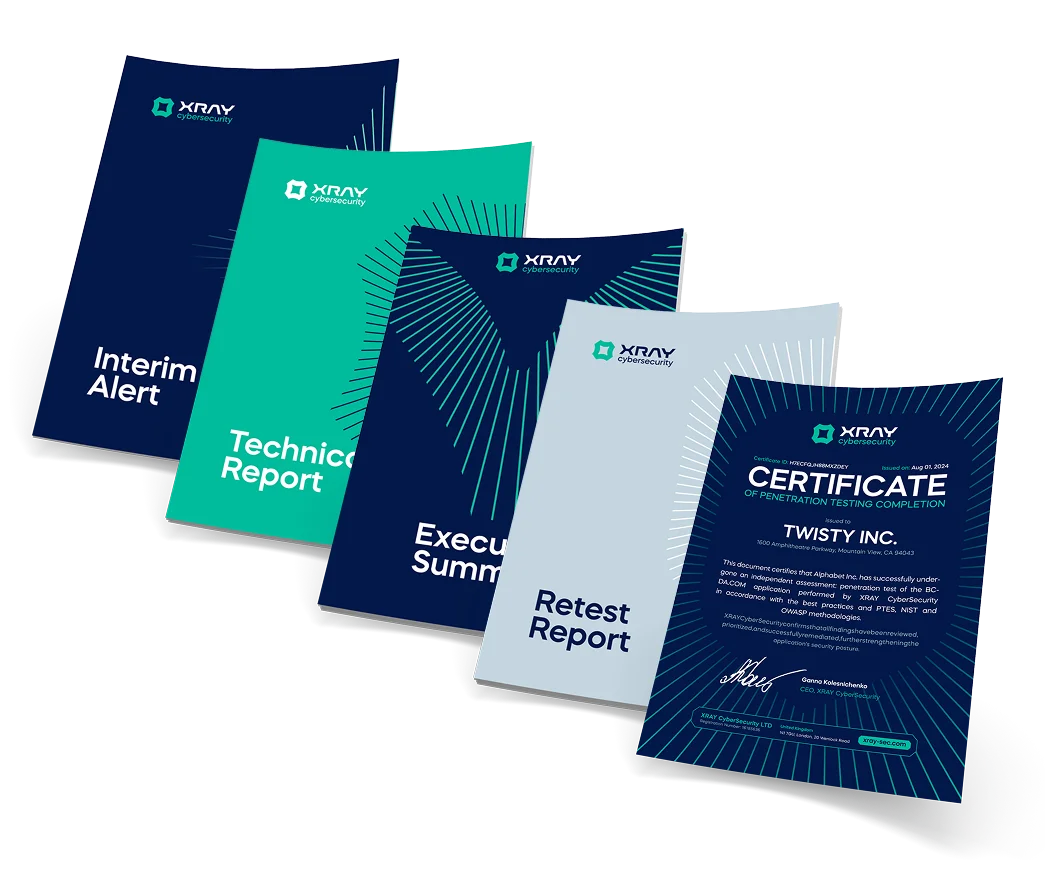
Real structure, real findings, real format. The same documents your team and your auditors will see.
When we find Critical, you find out today.
If we discover a Critical-severity vulnerability mid-engagement that needs immediate attention, you get an alert with reproduction steps and recommended actions. We keep testing, you start remediating in parallel. No waiting until the final report.
Prioritized findings your engineers can act on the same day.
Every vulnerability with reproduction steps, proof-of-concept exploitation, business impact, and a prioritized remediation roadmap. No false-positives. No filler. Built so your developers know exactly what to fix and in what order.
What the board and investors actually need to know.
A business-language report covering the security posture of your perimeter, the risks identified, their potential business impact, and the path to remediation. Written for CEOs, boards, investors, and Enterprise procurement teams — not engineers.
Verified evidence that the fixes actually work.
After your team remediates the findings, we re-test each one and confirm the fixes hold under the same exploitation attempts. The updated report is your proof that the vulnerabilities are actually closed — not just patched on paper.
A public-facing artifact you can share with customers and prospects.
After remediation and retest, we issue an official certificate confirming your external perimeter passed deep manual penetration testing. Use it on your website, in security questionnaires, in Enterprise sales conversations — the artifact your prospects and procurement teams want to see.
Industry-standard methodologies, executed by senior engineers.
Scanners run only as a baseline. Every finding is hand-built and verified by a senior engineer — exploited and chained manually, with your perimeter's context in mind.
Each finding feeds the next. New access reveals new attack surface. We loop back, dig deeper, and chain — until we reach the deepest impact your architecture allows.
A list of CVEs doesn't tell you what an attacker would actually do to your business. We translate every finding into a real-world scenario — what gets compromised, who loses what, and how the chain unfolds.
No juniors learning on your environment, no outsourced backfill, no swapping engineers mid-engagement. Every engagement is run by senior offensive engineers with deep external infrastructure and adversary-simulation experience.
We're not a conveyor optimizing for throughput. We take fewer engagements at a time and go deep on each — that's the trade-off.
All testing happens under signed Rules of Engagement. High-risk actions on production are coordinated with you in advance. Critical findings trigger an immediate alert — no surprises, no broken environments.
Every finding is verified, prioritized, and documented with reproduction steps and remediation guidance. Your engineers know exactly what to fix first — and they don't waste a day on noise.
Direct access to our engineers throughout the engagement. No sales translators, no project managers gatekeeping technical detail.
We hire engineers who hack on their own time — for research, for CTFs, for the love of the craft. Our team treats every engagement as a challenge to solve, not a ticket to close.
A structured engagement built around your team — with senior engineers, direct communication, and zero surprises.
Top-rated on industry platforms



Our engineers hold certifications including

XRAY CyberSecurity delivered a comprehensive, well-structured report with practical recommendations tailored to strengthening our application security. We received two reports — a detailed Technical and a separate Executive — which allowed us to quickly present results to leadership and build an action plan. Their readiness to communicate directly with our vendors significantly accelerated remediation.
XRAY CyberSecurity provided penetration testing for our products built on different technologies. We were able to discover vulnerabilities, fix them, and receive confirmation through retesting that they were mitigated. Communicating with their team felt more like working with coworkers than an external vendor — they were professional, knowledgeable, and gave us valuable advice.
XRAY CyberSecurity conducted gray-box penetration testing following OWASP methodologies. Their thorough manual analysis identified vulnerabilities worth attention, and their detailed technical and executive reports — followed by a retest validating our remediation — allowed us to proceed with ISO 27001 certification.
XRAY CyberSecurity conducted thorough assessments across our web applications and cloud environments, simulating real-world attack scenarios. Their detailed reports provided clear, actionable insights that significantly improved our security posture, and their ability to communicate complex findings in an understandable way was invaluable to our team.
The work was done quickly and professionally. XRAY CyberSecurity's specialists highlighted our vulnerable points, enabling us to improve our software quality. We received a report with detailed penetration scenarios and both technical and organizational recommendations for remediation and prevention.
The application test centers on the web app — UI flows, human workflows, client-side issues — and covers the APIs behind it as part of that surface. This engagement treats the API as the primary target: endpoint-level authorization, schema and method abuse, and machine-to-machine auth, at a depth a UI-driven test doesn’t reach. If your API is a product or a partner-facing interface, this is the right scope.
It accelerates us. A spec lets us cover every documented endpoint, method, and parameter systematically instead of inferring them. But we don’t stop at the spec — undocumented, deprecated, and shadow endpoints are often where the real findings are, so we hunt for those too.
An API hides its risk in object- and function-level authorization across every endpoint: proving that user A can reach user B’s data is slow, manual, per-object work. A broad-scope engagement covering network, app, and API in one pass rarely gets that deep before time runs out. We test APIs as a focused discipline, so we do — and that’s where the findings that matter come from.
Testing runs under signed Rules of Engagement. We control request volume to avoid load issues, and high-risk actions — anything mutating production data or stressing rate limits — are coordinated and approved before we run them. Test environments work too, as long as they mirror production authorization.
We ask for credentials in at least two separate tenants/accounts and systematically attempt cross-tenant access at the object and function level. Proving (or disproving) that tenant A can’t touch tenant B’s data is one of the highest-value outcomes of an API test.
Signed NDA and a contract with full corporate liability. Any data returned by the API during testing is stored encrypted, restricted to the assigned engineers, and deleted after the engagement per your contract. We carry professional indemnity insurance.
Setup is front-loaded — credentials across roles and tenants, the spec if you have one, and a short walkthrough of how the API is meant to be used. After that, occasional clarifying questions. Remediation time on your side is the larger investment, which we support directly.
Rare on APIs — authorization gaps are common — but if it happens, a clean result from a senior team is meaningful. You still receive the full deliverables documenting the endpoints, methods, and authorization paths tested — the artifact your auditor or customer needs.
The proposal price is fixed and in the contract against agreed scope. Retesting after remediation is included, with an updated report and Security Certificate. The only thing that changes the price is you expanding scope — more endpoints, services, or environments — agreed in writing before any work begins.