You’re not sure what’s actually exposed to the internet.
Assets get spun up, DNS records linger, services drift open. You have an asset list — but no confidence it matches what an attacker can reach right now.
Senior engineers attack your internet-facing perimeter the way a real adversary would — to find what’s exposed, prove what’s exploitable, and close the path before someone else walks it.
Trusted by





Assets get spun up, DNS records linger, services drift open. You have an asset list — but no confidence it matches what an attacker can reach right now.
A forgotten staging box, an open admin panel, a dev VPN left running. The dangerous host is usually the one nobody remembers — and confirming it’s reachable and exploitable is hands-on work, not a line in a report.
Renewal or a new policy now hinges on evidence that your perimeter has been independently tested. You need a real pentest report underwriters accept — not another questionnaire.
Their security team wants an independent test of your external footprint before they’ll sign or renew. The deal stalls until you hand over a report that holds up to their review.
An acquisition or merger doubled your attack surface overnight — unfamiliar hosts, unknown configs, undocumented exposure. You need to know what came with the deal before an attacker maps it for you.
An automated scan flags missing patches and weak TLS — it doesn’t chain a misconfigured service into actual access. You don’t know if a clean report means you’re safe, or just unscanned where it matters.
73%
of breaches involve external actors — and most start with a single weakness exposed to the internet: an open service, a weak credential, an unpatched edge device.
~15 min
is how fast a newly exposed internet-facing service is typically found and probed by automated adversary scanning.
1 host
is all it takes. Your perimeter is only as strong as its weakest reachable asset — and you only have to miss one.
Deep manual testing of everything an attacker can reach from the outside — and everything you forgot was reachable.
Unauthenticated external attacker simulation, starting from nothing but your domain or IP ranges. We discover what’s reachable before we attack it.
Same attack, accelerated. You share known assets, ranges, and context so we spend the engagement exploiting depth instead of re-discovering scope.
Most security work stops at finding a vulnerability. We treat that as the starting point.
A senior pentester (not a sales rep) will get back to you with an honest read on what would actually be worth testing.
A few engagements that show what working with us looks like — at scale, over years, across industries.
Blackbox and Greybox testing across multiple IT services — guaranteeing high protection for consumers, employees, contractors and shareholders while satisfying group-level compliance controls.
Read case studyBlackbox & Graybox testing aligned with OWASP — followed by remediation re-test and a final report that validated security posture for the ISO 27001 audit.
Read case studyFive deliverables — built for the people who'll actually use them: your engineers, your C-level, your auditors, and your insurers.
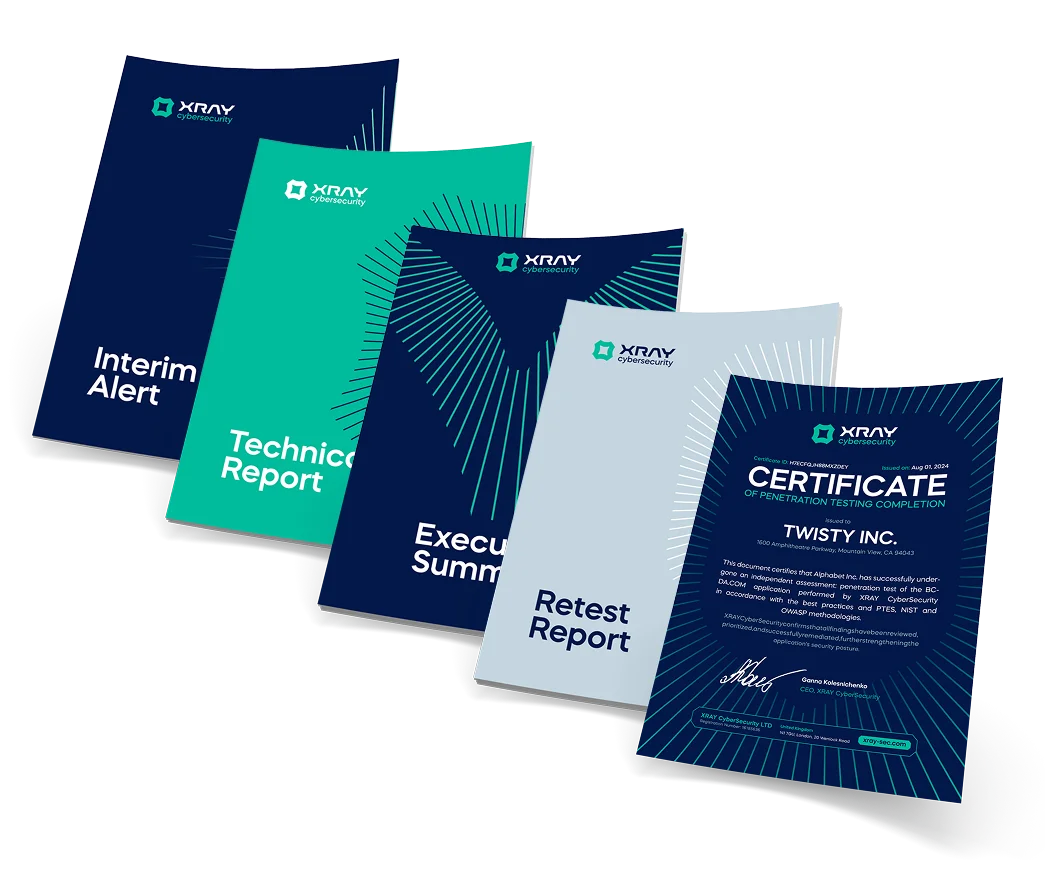
Real structure, real findings, real format. The same documents your team and your auditors will see.
When we find Critical, you find out today.
If we discover a Critical-severity vulnerability mid-engagement that needs immediate attention, you get an alert with reproduction steps and recommended actions. We keep testing, you start remediating in parallel. No waiting until the final report.
Prioritized findings your engineers can act on the same day.
Every vulnerability with reproduction steps, proof-of-concept exploitation, business impact, and a prioritized remediation roadmap. No false-positives. No filler. Built so your developers know exactly what to fix and in what order.
What the board and investors actually need to know.
A business-language report covering the security posture of your perimeter, the risks identified, their potential business impact, and the path to remediation. Written for CEOs, boards, investors, and Enterprise procurement teams — not engineers.
Verified evidence that the fixes actually work.
After your team remediates the findings, we re-test each one and confirm the fixes hold under the same exploitation attempts. The updated report is your proof that the vulnerabilities are actually closed — not just patched on paper.
A public-facing artifact you can share with customers and prospects.
After remediation and retest, we issue an official certificate confirming your external perimeter passed deep manual penetration testing. Use it on your website, in security questionnaires, in Enterprise sales conversations — the artifact your prospects and procurement teams want to see.
Industry-standard methodologies, executed by senior engineers.
Scanners run only as a baseline. Every finding is hand-built and verified by a senior engineer — exploited and chained manually, with your perimeter's context in mind.
Each finding feeds the next. New access reveals new attack surface. We loop back, dig deeper, and chain — until we reach the deepest impact your architecture allows.
A list of CVEs doesn't tell you what an attacker would actually do to your business. We translate every finding into a real-world scenario — what gets compromised, who loses what, and how the chain unfolds.
No juniors learning on your environment, no outsourced backfill, no swapping engineers mid-engagement. Every engagement is run by senior offensive engineers with deep external infrastructure and adversary-simulation experience.
We're not a conveyor optimizing for throughput. We take fewer engagements at a time and go deep on each — that's the trade-off.
All testing happens under signed Rules of Engagement. High-risk actions on production are coordinated with you in advance. Critical findings trigger an immediate alert — no surprises, no broken environments.
Every finding is verified, prioritized, and documented with reproduction steps and remediation guidance. Your engineers know exactly what to fix first — and they don't waste a day on noise.
Direct access to our engineers throughout the engagement. No sales translators, no project managers gatekeeping technical detail.
We hire engineers who hack on their own time — for research, for CTFs, for the love of the craft. Our team treats every engagement as a challenge to solve, not a ticket to close.
A structured engagement built around your team — with senior engineers, direct communication, and zero surprises.
Top-rated on industry platforms



Our engineers hold certifications including


XRAY CyberSecurity delivered a comprehensive, well-structured report with practical recommendations tailored to strengthening our application security. We received two reports — a detailed Technical and a separate Executive — which allowed us to quickly present results to leadership and build an action plan. Their readiness to communicate directly with our vendors significantly accelerated remediation.
XRAY CyberSecurity provided penetration testing for our products built on different technologies. We were able to discover vulnerabilities, fix them, and receive confirmation through retesting that they were mitigated. Communicating with their team felt more like working with coworkers than an external vendor — they were professional, knowledgeable, and gave us valuable advice.
XRAY CyberSecurity conducted gray-box penetration testing following OWASP methodologies. Their thorough manual analysis identified vulnerabilities worth attention, and their detailed technical and executive reports — followed by a retest validating our remediation — allowed us to proceed with ISO 27001 certification.
XRAY CyberSecurity conducted thorough assessments across our web applications and cloud environments, simulating real-world attack scenarios. Their detailed reports provided clear, actionable insights that significantly improved our security posture, and their ability to communicate complex findings in an understandable way was invaluable to our team.
The work was done quickly and professionally. XRAY CyberSecurity's specialists highlighted our vulnerable points, enabling us to improve our software quality. We received a report with detailed penetration scenarios and both technical and organizational recommendations for remediation and prevention.
Both. If you have an asset inventory we start there, but we don’t trust it as complete — discovering forgotten and shadow assets is part of the job. The most dangerous host is usually the one missing from your list, and we report scope drift back to you as a finding in its own right.
A scan tells you a service is potentially vulnerable; we prove whether it’s actually exploitable and what it gives an attacker. We chain a misconfiguration on one host into access on another — the work a scanner can’t do. You get exploited paths and business impact, not a list of CVEs to triage on your own.
No, and that’s by design. Every engagement runs under signed Rules of Engagement defining exactly what we test and how. High-risk actions — anything that could affect availability of a live service — are coordinated and only executed with your explicit approval.
We account for this up front. For major cloud platforms we follow their testing rules and, where required, coordinate authorization before testing hosted assets. We won’t put your account or hosting at risk to run a test.
Every engagement starts with a signed NDA and a contract with full corporate liability. Findings and any data accessed are stored encrypted, accessed only by the assigned engineers, and deleted after the engagement closes per the retention period in your contract. We carry professional indemnity insurance — if something goes wrong, you have a company to hold accountable.
Your call. We can run "dark" to test whether your team detects us, or coordinate notifications so testing doesn’t trigger an unnecessary incident response. We discuss this in the kickoff and adapt to what you want to measure.
Less than most expect. Setup is concentrated in the first days — confirming scope, ranges, and authorizations. After that your involvement is occasional clarifying questions. The real time investment is on your side during remediation, which runs on your timeline.
It’s rare, but it happens — and a clean result from a senior team is a meaningful one. You still receive the full deliverables: a report documenting the depth of testing, the methodology applied, and every asset covered — the same artifact your insurer, auditor, or customer needs.
The proposal price is the price you pay — fixed, in the contract, tied to agreed scope. Retesting after you remediate is included, with an updated report and Security Certificate. The only thing that changes the price is you expanding scope mid-engagement, and we agree any change in writing before work begins.