You’re defended at the edge — but blind on the inside.
Your perimeter holds. But if one laptop gets phished, what stops the attacker from reaching everything else? You don’t actually know how far a single foothold travels.
We assume the attacker is already inside — a phished employee, a rogue insider, a compromised laptop — and prove how far they get, how fast they reach Domain Admin, and where the path breaks.
Trusted by





Your perimeter holds. But if one laptop gets phished, what stops the attacker from reaching everything else? You don’t actually know how far a single foothold travels.
Years of group policies, nested permissions, and service accounts have piled up. You suspect there’s a path from a normal user to full domain control — you just haven’t had anyone prove it.
A contractor, a departing engineer, an over-permissioned account. You want to know what damage someone with legitimate internal access could do — before you find out the hard way.
Someone clicked, credentials leaked, and you contained it — you think. Now you need to know what that initial access could have unlocked, and whether your segmentation actually held.
A group-level mandate or audit requires internal pentests across subsidiaries and shared infrastructure. You need consistent, defensible results — not five different vendors with five different bars.
VLANs, zones, and firewall rules look right on the diagram. Whether they actually stop lateral movement is a different question, and the diagram won’t answer it.
85%
of Active Directory environments contain at least one exploitable path from a standard user account to Domain Admin.
Under 24h
is how long it typically takes to escalate from a single internal foothold to domain control on a network that’s never been tested.
1 click
is the realistic starting point. Edge defenses assume nothing gets in — internal testing assumes something already did.
Deep manual testing of what one foothold can become — and how far it travels before something stops it.
We start with a standard internal foothold — a low-privilege account or a planted device — and prove the path from there to domain dominance.
We test from the position of a real employee or contractor, across the roles and access levels people actually hold, to map what legitimate access can be abused.
Most security work stops at finding a vulnerability. We treat that as the starting point.
A senior pentester (not a sales rep) will get back to you with an honest read on what would actually be worth testing.
A few engagements that show what working with us looks like — at scale, over years, across industries.
Blackbox and Greybox testing across multiple IT services — guaranteeing high protection for consumers, employees, contractors and shareholders while satisfying group-level compliance controls.
Read case studyBlackbox & Graybox testing aligned with OWASP — followed by remediation re-test and a final report that validated security posture for the ISO 27001 audit.
Read case studyFive deliverables — built for the people who'll actually use them: your engineers, your C-level, your auditors, and your insurers.
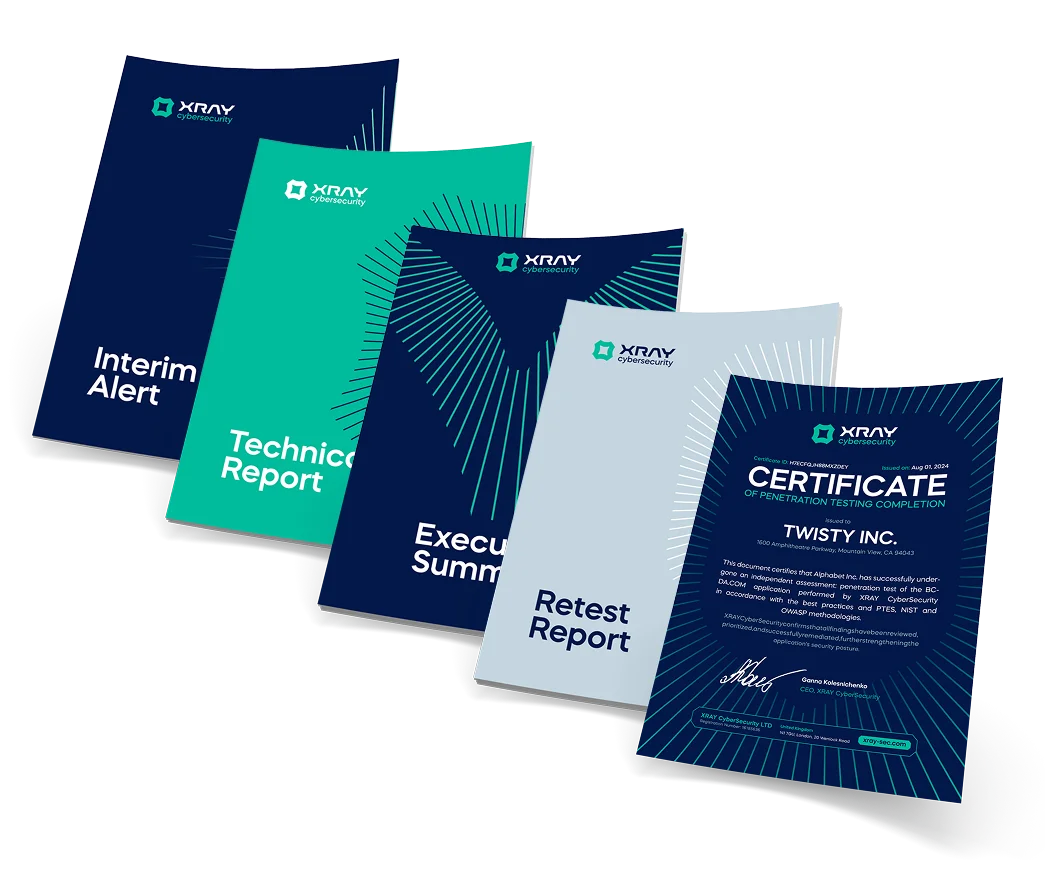
Real structure, real findings, real format. The same documents your team and your auditors will see.
When we find Critical, you find out today.
If we discover a Critical-severity vulnerability mid-engagement that needs immediate attention, you get an alert with reproduction steps and recommended actions. We keep testing, you start remediating in parallel. No waiting until the final report.
Prioritized findings your engineers can act on the same day.
Every vulnerability with reproduction steps, proof-of-concept exploitation, business impact, and a prioritized remediation roadmap. No false-positives. No filler. Built so your developers know exactly what to fix and in what order.
What the board and investors actually need to know.
A business-language report covering the security posture of your perimeter, the risks identified, their potential business impact, and the path to remediation. Written for CEOs, boards, investors, and Enterprise procurement teams — not engineers.
Verified evidence that the fixes actually work.
After your team remediates the findings, we re-test each one and confirm the fixes hold under the same exploitation attempts. The updated report is your proof that the vulnerabilities are actually closed — not just patched on paper.
A public-facing artifact you can share with customers and prospects.
After remediation and retest, we issue an official certificate confirming your external perimeter passed deep manual penetration testing. Use it on your website, in security questionnaires, in Enterprise sales conversations — the artifact your prospects and procurement teams want to see.
Industry-standard methodologies, executed by senior engineers.
Scanners run only as a baseline. Every finding is hand-built and verified by a senior engineer — exploited and chained manually, with your perimeter's context in mind.
Each finding feeds the next. New access reveals new attack surface. We loop back, dig deeper, and chain — until we reach the deepest impact your architecture allows.
A list of CVEs doesn't tell you what an attacker would actually do to your business. We translate every finding into a real-world scenario — what gets compromised, who loses what, and how the chain unfolds.
No juniors learning on your environment, no outsourced backfill, no swapping engineers mid-engagement. Every engagement is run by senior offensive engineers with deep external infrastructure and adversary-simulation experience.
We're not a conveyor optimizing for throughput. We take fewer engagements at a time and go deep on each — that's the trade-off.
All testing happens under signed Rules of Engagement. High-risk actions on production are coordinated with you in advance. Critical findings trigger an immediate alert — no surprises, no broken environments.
Every finding is verified, prioritized, and documented with reproduction steps and remediation guidance. Your engineers know exactly what to fix first — and they don't waste a day on noise.
Direct access to our engineers throughout the engagement. No sales translators, no project managers gatekeeping technical detail.
We hire engineers who hack on their own time — for research, for CTFs, for the love of the craft. Our team treats every engagement as a challenge to solve, not a ticket to close.
A structured engagement built around your team — with senior engineers, direct communication, and zero surprises.
Top-rated on industry platforms




Our engineers hold certifications including



XRAY CyberSecurity delivered a comprehensive, well-structured report with practical recommendations tailored to strengthening our application security. We received two reports — a detailed Technical and a separate Executive — which allowed us to quickly present results to leadership and build an action plan. Their readiness to communicate directly with our vendors significantly accelerated remediation.
XRAY CyberSecurity provided penetration testing for our products built on different technologies. We were able to discover vulnerabilities, fix them, and receive confirmation through retesting that they were mitigated. Communicating with their team felt more like working with coworkers than an external vendor — they were professional, knowledgeable, and gave us valuable advice.
XRAY CyberSecurity conducted gray-box penetration testing following OWASP methodologies. Their thorough manual analysis identified vulnerabilities worth attention, and their detailed technical and executive reports — followed by a retest validating our remediation — allowed us to proceed with ISO 27001 certification.
XRAY CyberSecurity conducted thorough assessments across our web applications and cloud environments, simulating real-world attack scenarios. Their detailed reports provided clear, actionable insights that significantly improved our security posture, and their ability to communicate complex findings in an understandable way was invaluable to our team.
The work was done quickly and professionally. XRAY CyberSecurity's specialists highlighted our vulnerable points, enabling us to improve our software quality. We received a report with detailed penetration scenarios and both technical and organizational recommendations for remediation and prevention.
External tests whether an attacker can get in; internal tests what happens once they’re already inside. We assume the perimeter has been bypassed — by phishing, a malicious insider, or a compromised device — and measure the blast radius from that foothold.
Usually a standard low-privilege domain account and either a device on your network or a connection we use to simulate a compromised host. We agree the exact starting position in the kickoff — it should mirror a realistic breach, not a privileged shortcut.
Testing runs under signed Rules of Engagement. We avoid disruptive techniques by default, and any action that could affect availability — restarts, aggressive relaying, anything touching critical systems — is coordinated and approved before we run it.
That’s often part of the value. You can have us run quietly to test detection and response, or coordinate with your SOC so testing doesn’t trigger a real incident. We discuss which you want to measure before we start.
Signed NDA and a contract with full corporate liability. Anything accessed during testing — including sensitive data found on internal shares — is stored encrypted, restricted to the assigned engineers, and deleted after the engagement per your contract. We carry professional indemnity insurance.
No — that would defeat the point. We escalate to privilege ourselves, the way an attacker would, starting from a normal user. If you want a faster, deeper review of specific configurations, we can also run a targeted authenticated pass, but the core test earns its access.
Setup is concentrated up front — provisioning the foothold and a kickoff on your environment. After that, mostly occasional clarifying questions. The larger investment is your team’s remediation time afterward, which we support with direct guidance.
Then we’ve done you a favor early — and we keep going. We document the full path, then continue mapping every other route in, what data is reachable, and where segmentation does or doesn’t hold, so remediation fixes the class of problem, not just one path.
The proposal price is fixed and written into the contract against agreed scope. Retesting after remediation is included, with an updated Technical Report and Security Certificate. The only thing that moves the price is you expanding scope, agreed in writing before any work begins.