You have no real number on how your team responds.
Training was done, posters went up — but you’ve never measured what happens when a convincing, tailored message actually lands. You’re guessing at your biggest risk.
We design phishing campaigns around your actual organization — your people, processes, and tools — to measure how your team responds to a realistic targeted attack, not a generic template they’d spot in a second.
Trusted by





Training was done, posters went up — but you’ve never measured what happens when a convincing, tailored message actually lands. You’re guessing at your biggest risk.
A mass "update your password" email everyone ignored proves nothing. Real attackers research your company first — a test that doesn’t isn’t testing the threat you actually face.
A real phishing email got through. You need to understand how it succeeded, who’s exposed, and whether the next one will land too — backed by an independent assessment, not internal guesswork.
SOC 2, ISO 27001, or a sector regulator now expects evidence of phishing resilience testing. You need a documented, independent campaign and report that satisfies the requirement.
As their vendor, you hold access to their environment or data. Their security team wants evidence your staff resists targeted phishing — before they’ll trust you with it.
Clicking is half the picture. The question that matters is whether someone raises the alarm fast enough for your SOC to react — and you’ve never put that to the test.
68%
of breaches involve a human element — phishing remains the most common way into an organization, across every industry and size.
Under 60 sec
is the median time for a user to click a phishing link and hand over credentials once a convincing, well-timed message lands.
1 reply
is enough. It takes one person, one tailored message, one credential — and the strength of your firewalls stops mattering.
Targeted campaigns built around how your people actually work — to measure both who falls for it and who reports it.
Messages crafted for specific individuals or teams using real context — names, tools, projects, and timing an attacker would research — to test resilience against a believable, personalized attack.
Full scenarios mirroring your actual processes (an invoice approval, an IT migration, an HR or vendor request) to test whether a plausible business story bypasses suspicion.
Most phishing tests stop at a click rate. We treat that as the starting point.
A senior pentester (not a sales rep) will get back to you with an honest read on what would actually be worth testing.
A few engagements that show what working with us looks like — at scale, over years, across industries.
Blackbox and Greybox testing across multiple IT services — guaranteeing high protection for consumers, employees, contractors and shareholders while satisfying group-level compliance controls.
Read case studyBlackbox & Graybox testing aligned with OWASP — followed by remediation re-test and a final report that validated security posture for the ISO 27001 audit.
Read case studyFive deliverables — built for the people who'll actually use them: your engineers, your C-level, your auditors, and your insurers.
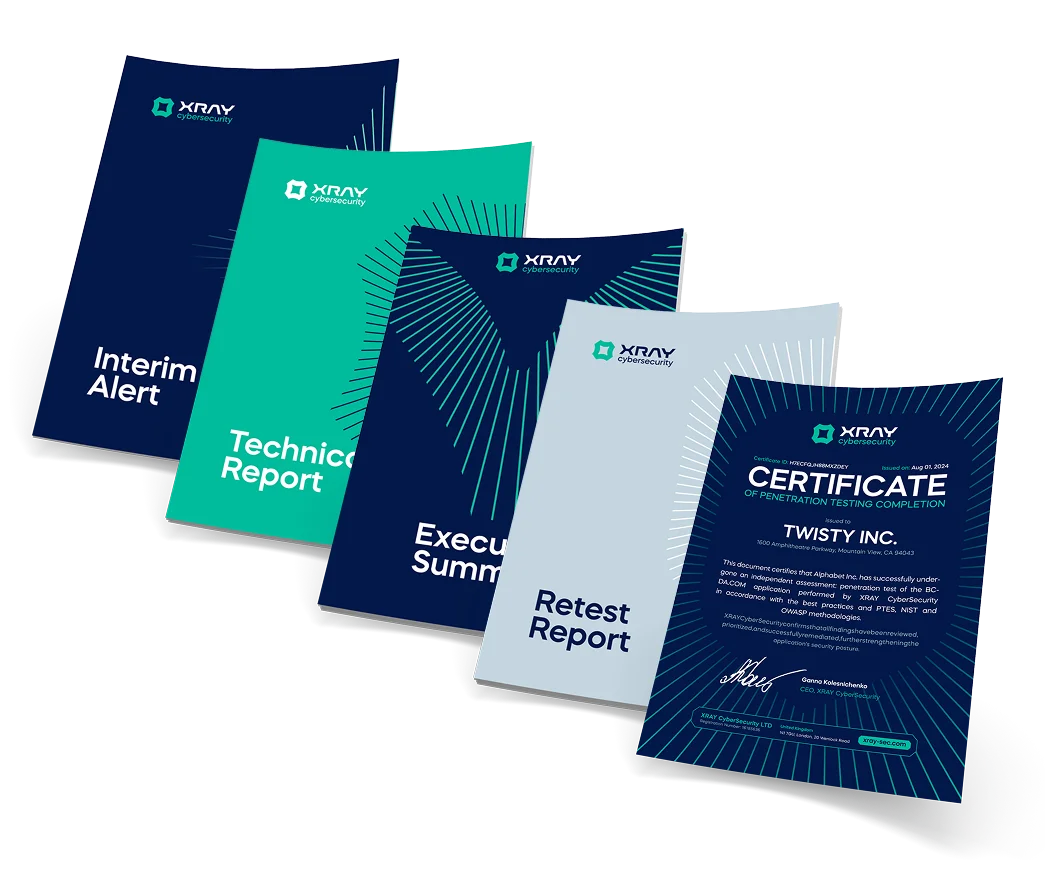
Real structure, real findings, real format. The same documents your team and your auditors will see.
When we find Critical, you find out today.
If we discover a Critical-severity vulnerability mid-engagement that needs immediate attention, you get an alert with reproduction steps and recommended actions. We keep testing, you start remediating in parallel. No waiting until the final report.
Prioritized findings your engineers can act on the same day.
Every vulnerability with reproduction steps, proof-of-concept exploitation, business impact, and a prioritized remediation roadmap. No false-positives. No filler. Built so your developers know exactly what to fix and in what order.
What the board and investors actually need to know.
A business-language report covering the security posture of your perimeter, the risks identified, their potential business impact, and the path to remediation. Written for CEOs, boards, investors, and Enterprise procurement teams — not engineers.
Verified evidence that the fixes actually work.
After your team remediates the findings, we re-test each one and confirm the fixes hold under the same exploitation attempts. The updated report is your proof that the vulnerabilities are actually closed — not just patched on paper.
A public-facing artifact you can share with customers and prospects.
After remediation and retest, we issue an official certificate confirming your external perimeter passed deep manual penetration testing. Use it on your website, in security questionnaires, in Enterprise sales conversations — the artifact your prospects and procurement teams want to see.
Industry-standard methodologies, executed by senior engineers.
Scanners run only as a baseline. Every finding is hand-built and verified by a senior engineer — exploited and chained manually, with your perimeter's context in mind.
Each finding feeds the next. New access reveals new attack surface. We loop back, dig deeper, and chain — until we reach the deepest impact your architecture allows.
A list of CVEs doesn't tell you what an attacker would actually do to your business. We translate every finding into a real-world scenario — what gets compromised, who loses what, and how the chain unfolds.
No juniors learning on your environment, no outsourced backfill, no swapping engineers mid-engagement. Every engagement is run by senior offensive engineers with deep external infrastructure and adversary-simulation experience.
We're not a conveyor optimizing for throughput. We take fewer engagements at a time and go deep on each — that's the trade-off.
All testing happens under signed Rules of Engagement. High-risk actions on production are coordinated with you in advance. Critical findings trigger an immediate alert — no surprises, no broken environments.
Every finding is verified, prioritized, and documented with reproduction steps and remediation guidance. Your engineers know exactly what to fix first — and they don't waste a day on noise.
Direct access to our engineers throughout the engagement. No sales translators, no project managers gatekeeping technical detail.
We hire engineers who hack on their own time — for research, for CTFs, for the love of the craft. Our team treats every engagement as a challenge to solve, not a ticket to close.
A structured engagement built around your team — with senior engineers, direct communication, and zero surprises.
Top-rated on industry platforms




Our engineers hold certifications including



XRAY CyberSecurity delivered a comprehensive, well-structured report with practical recommendations tailored to strengthening our application security. We received two reports — a detailed Technical and a separate Executive — which allowed us to quickly present results to leadership and build an action plan. Their readiness to communicate directly with our vendors significantly accelerated remediation.
XRAY CyberSecurity provided penetration testing for our products built on different technologies. We were able to discover vulnerabilities, fix them, and receive confirmation through retesting that they were mitigated. Communicating with their team felt more like working with coworkers than an external vendor — they were professional, knowledgeable, and gave us valuable advice.
XRAY CyberSecurity conducted gray-box penetration testing following OWASP methodologies. Their thorough manual analysis identified vulnerabilities worth attention, and their detailed technical and executive reports — followed by a retest validating our remediation — allowed us to proceed with ISO 27001 certification.
XRAY CyberSecurity conducted thorough assessments across our web applications and cloud environments, simulating real-world attack scenarios. Their detailed reports provided clear, actionable insights that significantly improved our security posture, and their ability to communicate complex findings in an understandable way was invaluable to our team.
The work was done quickly and professionally. XRAY CyberSecurity's specialists highlighted our vulnerable points, enabling us to improve our software quality. We received a report with detailed penetration scenarios and both technical and organizational recommendations for remediation and prevention.
Off-the-shelf tools send templated emails at scale; a real attacker researches your company first. We build campaigns around your actual people, tools, and processes — the way a motivated adversary would — so the result reflects the threat you face, not a test anyone could spot.
No — this engagement is phishing only, by design. We focus on doing targeted email-based social engineering properly rather than spreading across vectors. If you need broader red-team scope, that’s a separate conversation.
No. The goal is measuring organizational resilience, not naming and shaming. Results are reported as aggregate metrics and patterns; individual data is handled sensitively and per what we agree up front. The output is a stronger team, not a blame list.
Signed NDA and a contract with full corporate liability, plus written authorization for the campaign before anything is sent. Any credentials or data captured during testing are stored encrypted, restricted to the assigned engineers, and deleted after the engagement per your contract. We carry professional indemnity insurance.
Usually not the targets — advance warning defeats the test. But we always coordinate with a small, agreed group on your side (and, if relevant, your SOC) so the engagement is authorized and controlled. You decide who’s in the know before we start.
More than click rate. We measure who clicked, who entered credentials, who approved an MFA prompt — and critically, who reported it and how fast your team and SOC responded. Reporting and response are as important as the click, and we report on both.
That’s a strong result — and a meaningful one. You still receive full deliverables documenting the campaigns run, the pretexts used, the targets, and the response metrics — evidence of resilience your auditors and customers will accept.
Setup is front-loaded — agreeing scope, targets, pretexts, and authorization at kickoff. During the campaign your involvement is minimal beyond the coordinating group. After delivery, the value comes from acting on the findings, which we support with clear, prioritized guidance.
The proposal price is fixed and in the contract against agreed scope. A follow-up campaign to measure improvement after awareness work can be included or scoped explicitly — agreed up front, not billed as a surprise. The only thing that changes the price is you expanding scope, agreed in writing first.